How to plan your day when most of it isn't up to you
How to plan your day in ten minutes when meetings and requests fill your calendar, with a simple daily template and a real example.
Oct 17, 2026
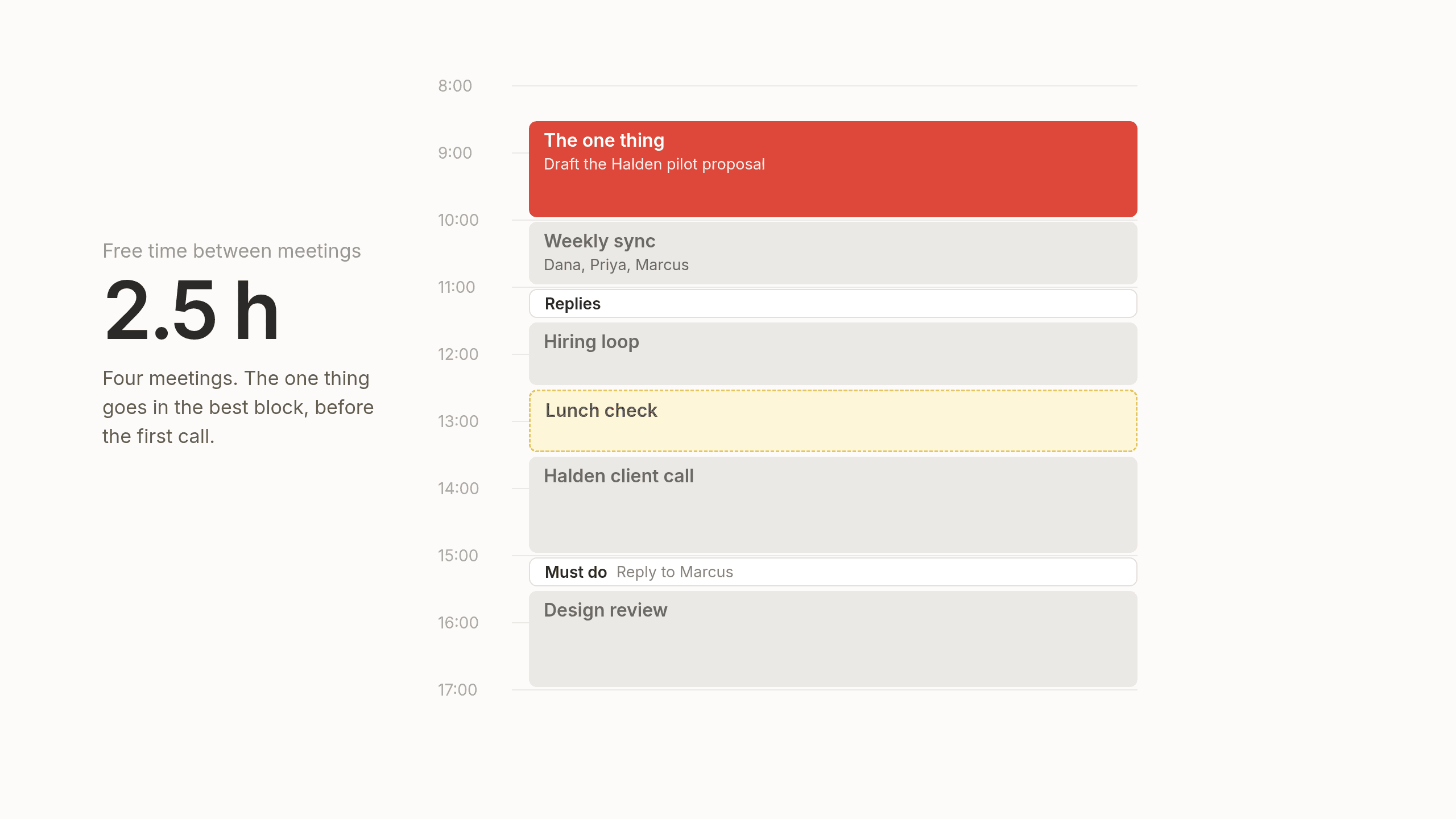
Here's how to plan your day in about ten minutes. Look at your calendar first and count the free time you really have. Pick one important thing and at most two smaller must dos, put the important one in your best free block and leave room for whatever comes up. Then look at the plan again around lunch.
We wrote this for the days when your calendar seems to belong to everyone except you. If you've ever closed your laptop at seven, done plenty of work and still felt like you got nothing done, this one's for you.
Why ten minutes of planning makes the day calmer
Most advice about planning your day assumes the hours are yours to arrange. If you're a founder, a manager or anyone whose work runs through other people, they mostly aren't. Meetings and requests fill a large part of the day. An hour by hour schedule usually doesn't survive past ten in the morning and a list of twenty items mostly serves as a record of what you didn't get to. None of that means you're bad at planning. It means the plan was written for a different kind of day.
Planning still helps. The reason isn't only that more gets done. In 2011 E. J. Masicampo and Roy Baumeister published a study called "Consider it done! Plan making can eliminate the cognitive effects of unfulfilled goals" in the Journal of Personality and Social Psychology. Unfinished tasks kept coming back into people's heads while they tried to focus on something else. Making a specific plan for those tasks reduced that, even before any of the work was done. Deciding when you'll do something is enough to let your mind put it down for a while.
How to plan your day in seven steps
You can do this at the end of the previous day or first thing in the morning, ideally before the first message pulls you in. The whole routine starts with the time you have, which is usually less than the time you'd like to have.
1. Look at your calendar first. Count the free time between meetings and be honest about it. If you have four hours of calls, you don't have an eight hour day of work ahead of you. You have about three hours, plus a few gaps that are too short for anything serious.
2. Empty your head. Write down everything that's on your mind in one place, including the follow-up you promised yesterday and the reply you keep putting off. It's much easier to choose when you can see everything at once.
3. Pick one important thing. The task that would make today worth it if nothing else happened. It's fine if it's small. Then choose at most two smaller must dos. Everything else goes under "if there's time", which is a kinder heading than "things I'll feel bad about later".
4. Put the important thing in your best free block, ideally before you open your inbox. If you only have thirty minutes, plan a thirty minute version of it, like the outline instead of the whole document. There's a reason to do this early. In 2018 Meng Zhu, Yang Yang and Christopher Hsee published "The mere urgency effect" in the Journal of Consumer Research. People kept choosing tasks that only felt urgent because of a short deadline over tasks that would have paid off more. Your inbox is full of those.
5. Leave room. Plan only about half of your free time. This will feel like too little. It's usually about right. Requests and surprises will use the rest and tasks take longer than we expect. Daniel Kahneman and Amos Tversky called this the planning fallacy in 1979. People underestimate how long things will take, even when similar things ran late before.
6. Check again around lunch. Treat the morning plan as a first guess, because that's what it is. Look at what changed, move what no longer fits and decide what the afternoon is for.
7. Spend two minutes at the end of the day. Write down what's left and what tomorrow's important thing is, so the next morning starts with a decision already made.
A daily plan template
You don't need special software for this. A plain note works fine and there's nothing to set up when your first call is in five minutes. Copy it, keep it somewhere you'll see it and make it yours.
Today, [day and date]

Free time between meetings: [hours]

The one thing: [What would make today worth it]
When: [Time block]

Must dos (max two):
- [Task]
- [Task]

If there's time:
- [Task]

Waiting on others:
- [Who and what]

Lunch check: [What changed and what the afternoon is for]

Tomorrow's one thing: [Write it before you log off]
Here's Sam's plan for a day with four meetings and about two and a half free hours.
Today, Tuesday

Free time between meetings: 2.5 hours

The one thing: Draft the Halden pilot proposal
When: 8:30 to 10:00, before the first call

Must dos (max two):
- Review Priya's onboarding designs
- Reply to Marcus about the security summary

If there's time:
- Clean up Q4 hiring notes

Waiting on others:
- Dana to confirm the board pack deadline

Lunch check: Client call moved to the afternoon, so the design review moves to tomorrow.

Tomorrow's one thing: Review Priya's onboarding designs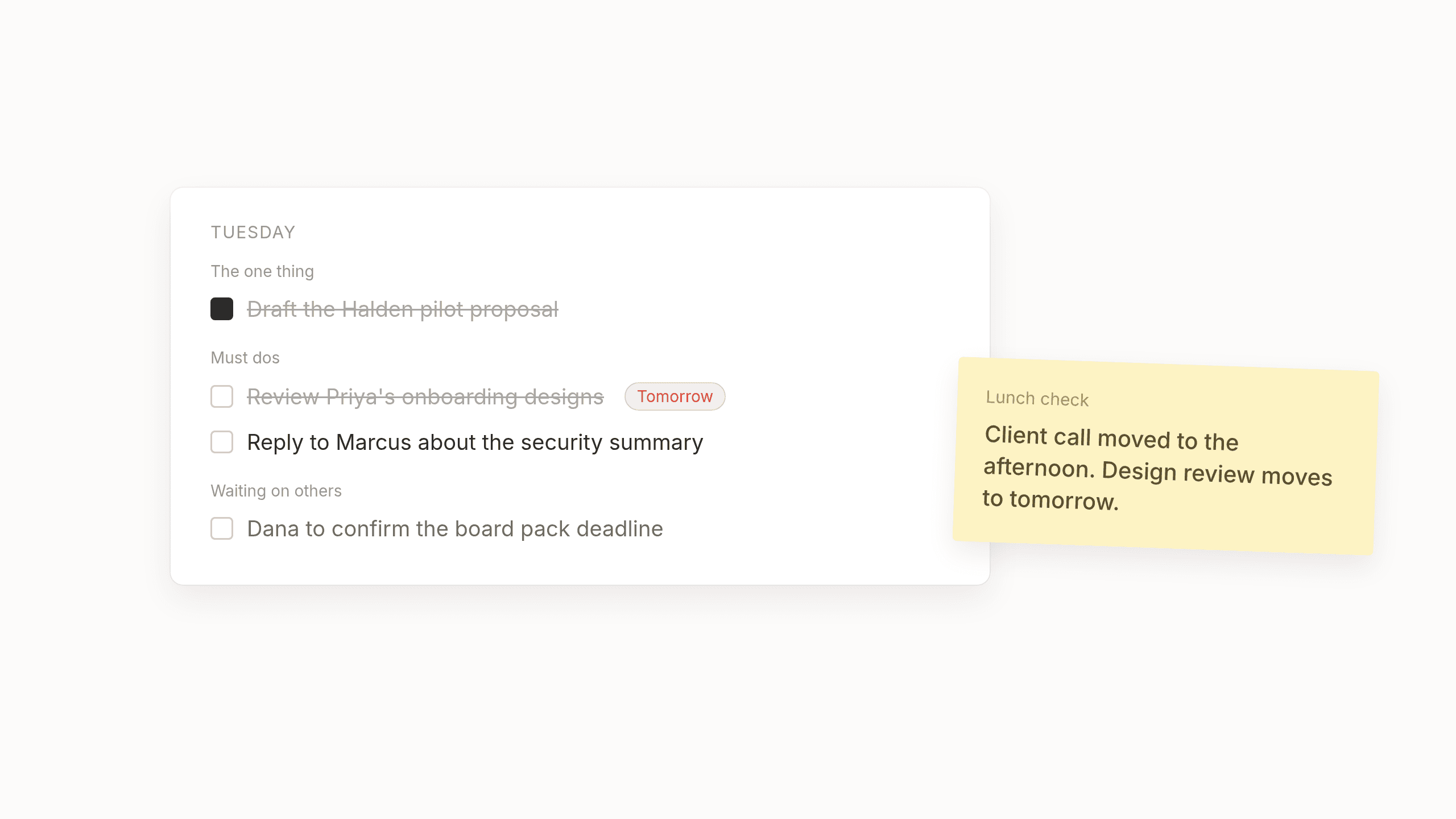
The proposal gets done before the calls start. When the afternoon changes, the design review moves to Wednesday on purpose. Sam doesn't spend the evening wondering why it didn't happen, because it was decided at lunch.
How to plan your work day when it's full of meetings
We all have days where the calendar is meetings from nine to five with a few thin gaps in between. On those days, treat the meetings as fixed and plan the gaps. Put your important thing in the biggest gap, even if it's only an hour and shrink it to something you can finish in that time. Quick replies and scheduling fit in the fifteen minute gaps between calls, where you wouldn't get deep work done anyway.
If there's no gap longer than thirty minutes, it's a meetings day. Plan only small tasks and protect a proper block on tomorrow's calendar for the bigger work. And write down promises as you make them in those meetings. They're tomorrow's must dos and by five o'clock you won't remember half of them.
Other ways to shape a day
If you have more control over your hours, a few other methods are worth knowing.
Oliver Burkeman's 3-3-3 method, from his newsletter The Imperfectionist, gives three hours to your most important project, then three shorter urgent or nagging tasks and three maintenance activities that keep life running. He says the principles matter more than the exact numbers, which helps on days when you only get ninety minutes for the main project.
The 1-3-5 rule plans one big task, three medium ones and five small ones. Alexandra Cavoulacos, cofounder of The Muse, created it and describes it in The New Rules of Work, which she wrote with Kathryn Minshew.
The Ivy Lee method is for people who like to plan the night before. At the end of each day you write down the six most important things for tomorrow, rank them and work through them in order. The story goes that Lee taught it to Charles Schwab of Bethlehem Steel around 1918.
| Method | How it works | Works best when |
|---|---|---|
| The routine above | One important thing and up to two must dos in half your free time | Your days are full of meetings and requests |
| 3-3-3 | Three hours on one project, three short tasks, three maintenance tasks | You can find a long uninterrupted block |
| 1-3-5 | One big, three medium and five small tasks | You control most of your own hours |
| Ivy Lee | Six tasks written and ranked the night before | Your priorities don't change much during the day |
Common mistakes
Most of us have made all of these at least once. The most common one is planning eight hours of focused work into a day with three free hours. Another is starting with email, which lets whoever wrote to you last decide what your morning is about. A list with no single most important item means everything gets the same attention and the important work loses to the easy work.
It also doesn't help to treat the morning plan as a promise and then feel behind when a call runs long. Adjusting at lunch is part of the plan. And if you find yourself color coding and rearranging for half an hour, the planning has become the task.
A plan that's ready when you sit down
The routine above works, but the first few steps are gathering. Before you can choose what matters, you need to find what you promised in yesterday's meetings, check which emails still need an answer and remember what you're waiting on from whom. On a busy morning with a call at nine, that's the part that gets skipped.
We built Lemongraph, an AI native personal task manager for people whose work runs through other people, like founders, managers and consultants, to do that gathering. It picks up tasks from your meetings and email without you copying them over. Every morning Up next shows what matters today and why. Daily priority triage is included on every plan, including the free one.
When it orders your day, it looks past due dates at the work and the people connected to each task. Due dates still count, they just don't get the final say. We wrote more about how we think about that in our guide on how to prioritize tasks. Every item shows why it's there, so you can see the reasoning and disagree with it. When plans change, you can snooze anything and it comes back when you're ready.
Lemongraph asks before every action. When you're ready, you can give it permission in small steps, one chore or one contact at a time. It runs on the web and Mac. The free plan includes 5 integrations and 15 chore runs a month and Pro is $20 a month for 100.
You still choose the one thing for your day. Lemongraph does the gathering and gives you a starting order you can change.
However you plan, we hope tomorrow starts with one thing you're glad to get done and a little room left over for everything you can't predict.
Frequently asked questions
What is the best way to plan my day?
Start with your calendar and count the free time between meetings. Pick one important thing and at most two smaller must dos, put the important one in your best free block before you check email, leave about half your free time unplanned and look at the plan again at lunch.
What is the 3-3-3 rule for tasks?
It's Oliver Burkeman's method from his newsletter The Imperfectionist. You spend three hours on your most important project, do three shorter urgent or nagging tasks and take care of three maintenance activities. He says the idea matters more than the exact numbers.
How should I plan my day today?
Take ten minutes now. Count the free time between today's calls, write down everything on your mind, choose the one task that would make today worth it and block time for it before you open your inbox. Add no more than two other must dos.
Should I plan my day the night before or in the morning?
Either works. Planning the night before means you still remember what's left over. If you do, glance at your calendar in the morning in case something moved overnight.
How many tasks should I plan for one day?
One important task and up to two smaller must dos. Tasks usually take longer than we expect, so a short list you finish is more useful than a long one that rolls over all week.
Is there an app that plans my day for me?
An app shouldn't decide what your most important work is, since you know what's at stake better than it does. Lemongraph picks up tasks from your email and meetings and gives you a starting order in Up next each morning, with the reason for each item, so choosing takes less time.
The Eisenhower Matrix: how it works, a free template and where it falls short
The Eisenhower Matrix sorts tasks by urgent and important into four boxes. A free template, a real example, the true history and where it falls short.
Meeting agenda template: how to prepare an agenda that makes meetings shorter
A free meeting agenda template with a filled in example, versions for one on ones, client meetings and team weeklies and how to write one.