How to prioritize tasks at work when everything feels urgent
How to prioritize tasks when everything feels urgent. Five practical steps, the classic methods with their real origins and why work needs a new approach.
Sep 23, 2026
Here's the short version of how to prioritize tasks. Get everything out of your head and into one place, then separate what genuinely matters from what's only being loud about it. Pick a small handful of things that must happen today and give the most important one your best hours, before the inbox gets a vote. And when the afternoon rearranges itself, as afternoons do, look at the list again and change the order without feeling guilty about it.
That's the whole idea. The rest of this guide is about making it work on a real Tuesday, where a lot of what you need to do wasn't your idea in the first place.
Why prioritizing feels harder than it should
On paper none of this is complicated, which is part of what makes it so frustrating. You know you should do the important thing first. And yet a messy list has a way of making you tired before you've started.
There's a good reason for that. In 2011 the psychologists E. J. Masicampo and Roy Baumeister published a study with the wonderfully confident title "Consider it done! Plan making can eliminate the cognitive effects of unfulfilled goals." They found that unfinished goals keep elbowing their way into your thoughts while you're trying to focus on something else, a bit like a tab you forgot to close that keeps playing music. What quieted them wasn't finishing the work. It was making a specific plan for it. Simply deciding when and how something would get done was enough to let the mind put it down for a while.
So prioritizing isn't only about getting more done. It's also how you get a little peace while you do it.
How to prioritize tasks in five steps
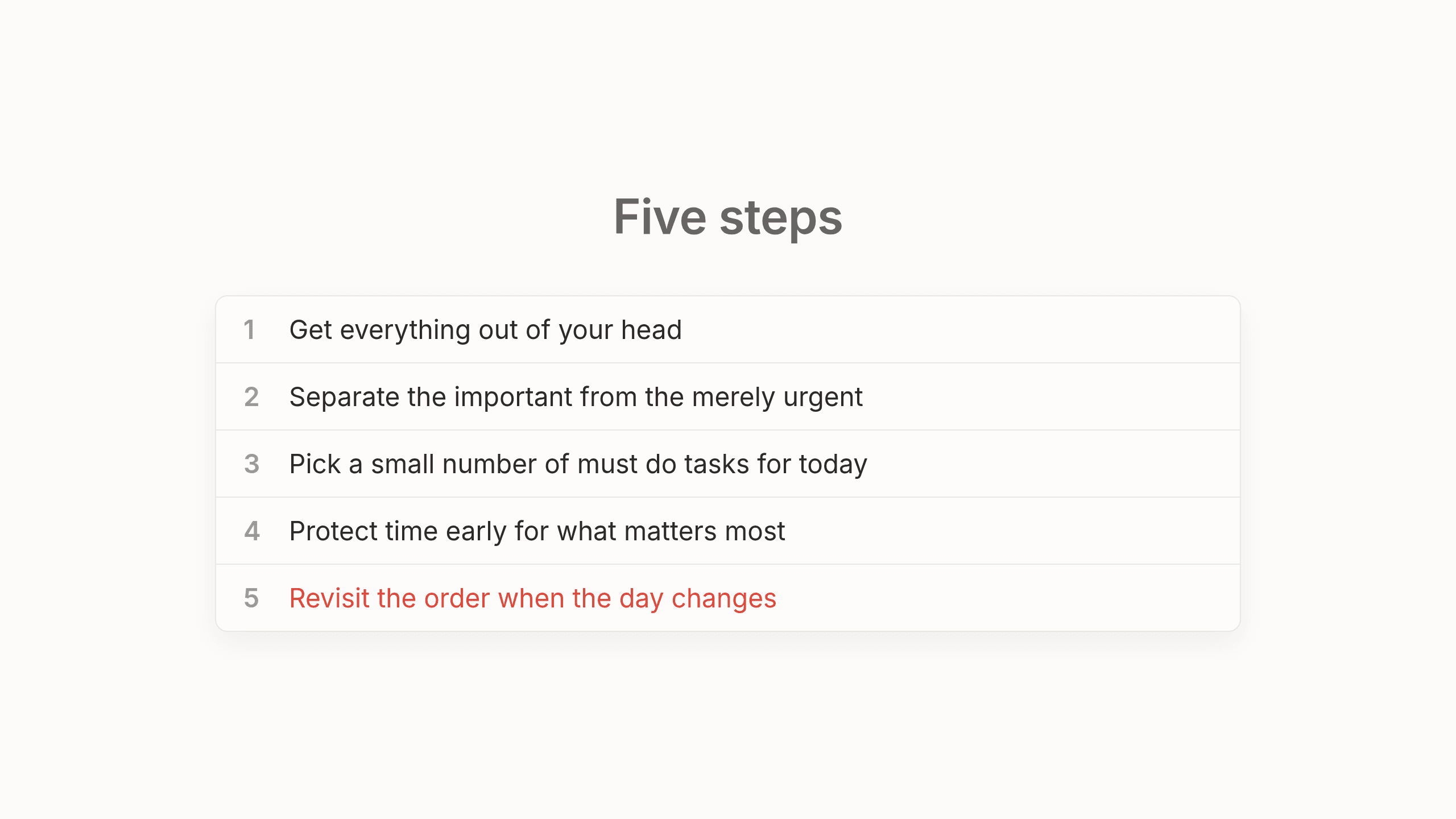
A lot of productivity advice takes one good idea and stretches it across forty pages. A surprising amount of it gets the history wrong. Here's the plain version, with credit given where it's actually due.
1. Get everything out of your head
Your memory is a lovely place for birthdays and a terrible place for a to-do list. When you try to hold every promise you made in a hallway or at the end of a call, your mind spends its energy on not forgetting rather than on thinking. Write every task down in one place, even the small embarrassing ones, so you can stop rehearsing the list and start looking at it.
2. Separate the important from the merely urgent
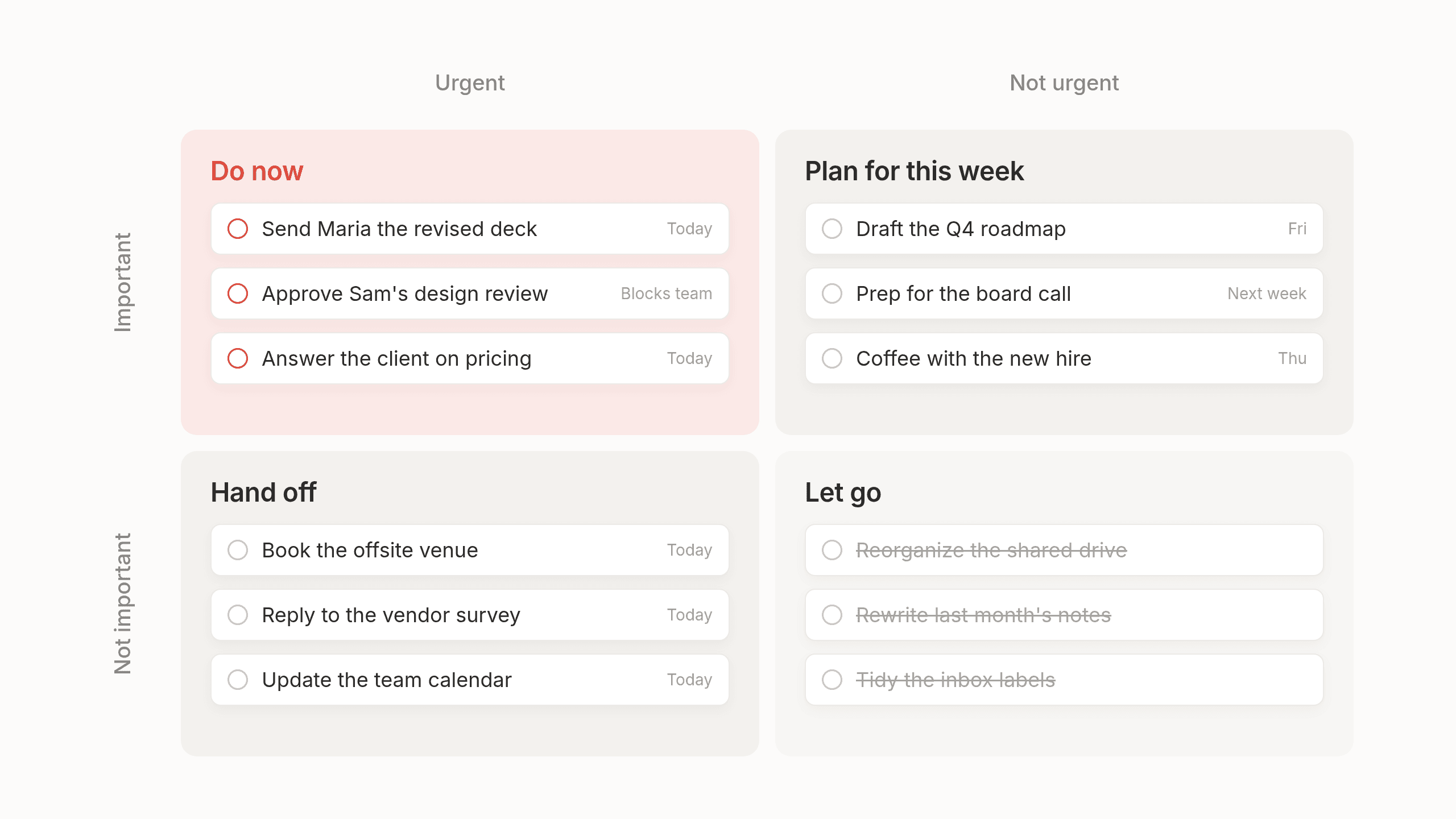
Once the list is in front of you, sort what matters from what's just making noise. This idea is usually credited to Dwight Eisenhower, who in a 1954 speech at Northwestern University said "I have two kinds of problems, the urgent and the important. The urgent are not important and the important are never urgent."
The charming twist, according to Quote Investigator, is that he was quoting an unnamed former college president. The most famous line ever spoken about priorities was borrowed. Decades later Stephen Covey turned the idea into the four box grid we now call the Eisenhower Matrix in The 7 Habits of Highly Effective People and it's been on whiteboards ever since.
3. Pick a small number of must do tasks for today
Thirty items isn't a plan for a day. It's a list of everything that could possibly happen to you.
One of the oldest answers comes from the consultant Ivy Lee, who around 1918 gave Charles Schwab, then president of Bethlehem Steel, a routine that fits on an index card. At the end of each day you write down the six most important things for tomorrow, rank them and work through them in order, carrying over whatever's left. The story goes that Schwab was so pleased he later sent Lee a check for $25,000, though James Clear points out that the earliest written versions of that story appeared decades later.
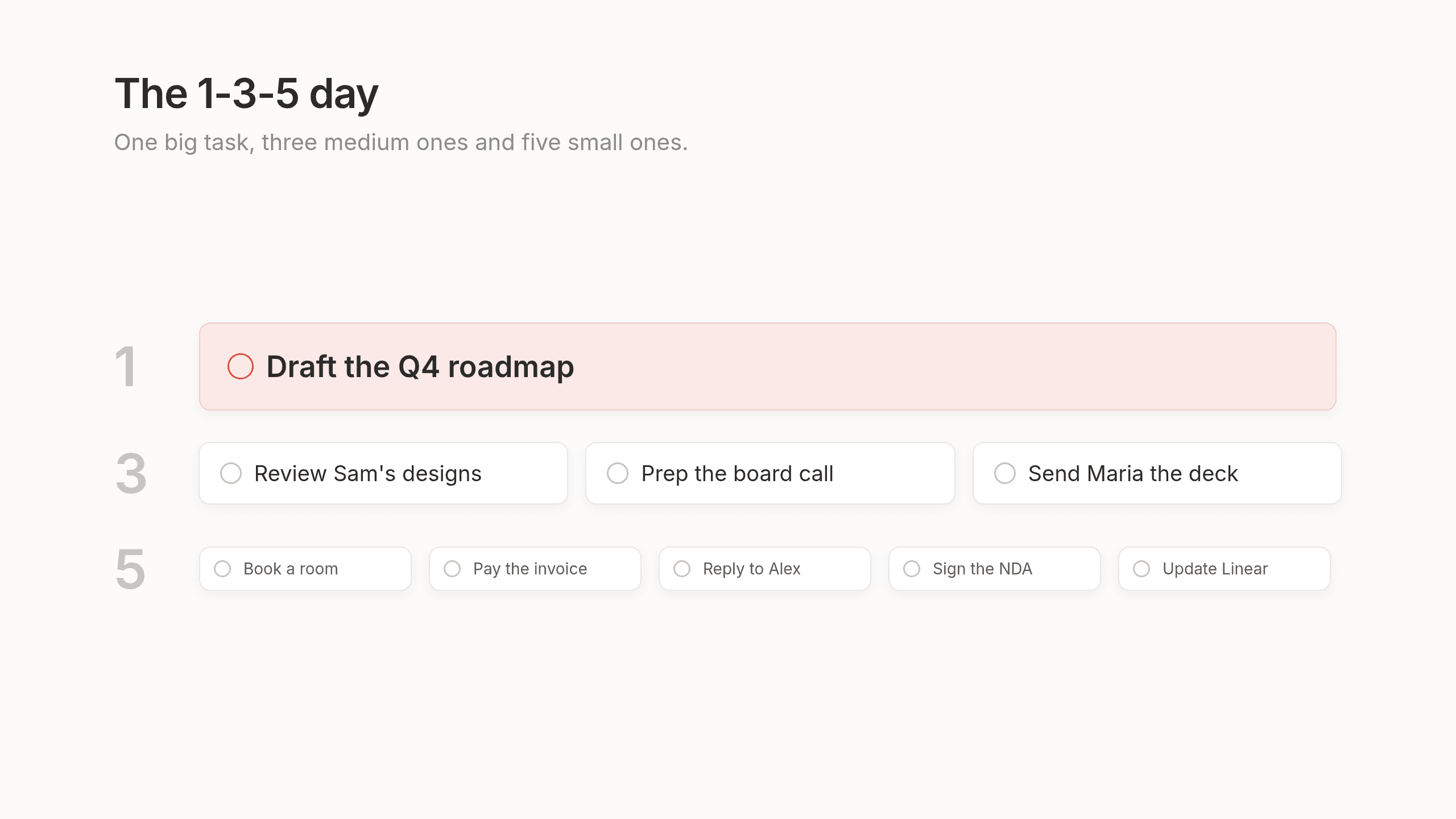
If six feels arbitrary, there are gentler shapes. The 1-3-5 rule asks for one big task, three medium ones and five small ones. It was created by Alexandra Cavoulacos, cofounder of The Muse, who describes it in The New Rules of Work, written with Kathryn Minshew. Oliver Burkeman's 3-3-3 method, from his newsletter The Imperfectionist, gives three hours to your most important project, then makes room for three shorter tasks and three bits of maintenance that keep life running. Burkeman is refreshingly relaxed about it and says the principles matter more than the exact numbers.
4. Protect time early for what matters most
If your biggest task is waiting for the afternoon, the afternoon will find a way to eat it. Covey's version of this is the jar of big rocks. Put the big rocks in first and the gravel and sand settle around them, but start with the sand and the rocks never fit.
Brian Tracy made a similar habit famous in his book Eat That Frog!, where you tackle your hardest task first thing in the morning. People love to credit the frog to Mark Twain, but Quote Investigator found no evidence he ever said it. It traces back to the French writer Nicolas Chamfort, writing in the 1790s about swallowing a toad every morning. Somewhere along the way the toad became a frog and the frog became Mark Twain's.
5. Revisit the order when the day changes
No morning plan survives a busy workday intact. That's not a personal failing. Treat your morning list as a good first guess rather than a contract. A quick look after lunch, where you trade out what no longer fits, will do more for you than trying to defend a plan the day has already moved past.
How to prioritize tasks at work when they come from other people
Everything above works beautifully when you control your own schedule. To prioritize tasks at work is a different game, because most of what lands on your plate starts with somebody else. A client sends an email. Your manager drops a quick request just as a call is wrapping up. Two projects both swear their Friday deadline is the real one.
When you're juggling multiple projects or multiple deadlines, your own preferences are only half the picture. The other half is who's waiting and what happens if they keep waiting. A few habits help a lot here.
Ask what each task unblocks and for whom. A ten minute review that lets a whole team keep moving matters far more than a solo task with a deadline someone picked at random.
Negotiate the scope before you move the date. If two people need something today, a rough one page answer now is often worth more to them than a polished report next week. It's worth asking.
Say no or not yet, plainly. People cope much better with a clear "not this week" than with a warm maybe that quietly turns into a broken promise.
Tell people when their thing moves. If a fire pushes someone's request to tomorrow, let them know before they have to come and ask. It costs you one message and keeps a little of their trust intact.
Techniques to prioritize tasks, side by side
It helps to see the techniques to prioritize tasks next to each other. We've added one more, Brian Tracy's ABCDE method, where you label each task A for must do, B for should do, C for nice to do, D for delegate or E for eliminate.
| Method | How it works | Best when | Watch out for |
|---|---|---|---|
| Eisenhower Matrix | Sort tasks into four boxes by urgency and importance | Other people's requests are drowning out your own work | Spending more time sorting boxes than doing the work |
| Ivy Lee method | Write down six important tasks each evening and rank them | You want a simple routine for tomorrow | Surprises breaking your order before noon |
| 1-3-5 rule | Plan one big, three medium and five small tasks | Your day mixes deep work with quick errands | Inventing nine tasks when four would do |
| 3-3-3 method | Three hours of deep work, three short tasks, three maintenance tasks | You need to protect focus for one big project | Meetings chopping up your three hours |
| Eat the frog | Do the hardest important task first thing | You tend to put off big scary work | Morning fires pulling you away early |
| Big rocks | Schedule your most important commitments before anything else | You plan your week on a calendar | Underestimating how big the rocks really are |
| ABCDE method | Label tasks from A for must do down to E for eliminate | You have a long flat list that needs quick triage | Marking everything as an A out of habit |
If you take one thing from this table, let it be this. Pick the one method that fits the shape of your day and give it two honest weeks. Stacking three of them on a busy Tuesday is just a more elaborate way of not starting.
Why the classic methods break at work
We like every method in that table. But they all quietly assume two things that don't hold for long at work. They assume your list is complete and they assume you'll sit down regularly in a quiet moment to sort it by hand. In practice your real list is scattered across your inbox, your meeting notes, a project tracker and the back of your mind and the quiet moment rarely arrives.
Even when you do gather everything, due dates pull on us much harder than they should. In 2018 Meng Zhu, Yang Yang and Christopher Hsee published a paper called "The mere urgency effect" in the Journal of Consumer Research. Across five experiments, people kept choosing tasks that simply had a short deadline over tasks with objectively better payoffs. Zhu described it as "an illusion of expiration", which might be the most accurate description of a Monday inbox we've ever read. A to-do list sorted by due date doesn't fight that bias. It trains it, a little more every day.
And then there's time itself. A morning ranking is a snapshot and the day keeps moving the second you take it. By lunch the order is out of date and nobody has told your list.
None of this means the methods are wrong. They're wonderful thinking tools. But asking a busy person to rerun the Eisenhower Matrix by hand every few hours isn't really a system. It's homework.
Reimagining how prioritizing should feel
So we've been asking a simple question. What would prioritizing feel like if someone designed it from scratch for how work actually happens now, instead of for a desk with a notepad and an uninterrupted hour?
We think it would start with not having to gather the list at all. Tasks would arrive on their own from the conversations where work happens, rather than waiting for you to copy them over between meetings.
The order would look past the due date, at the work and the people connected to each task. Sometimes a small favor for the person your biggest project depends on matters more than the report that happens to be due Friday and a good colleague would know that without being told.
It would keep up when plans change, so a meeting moving at noon doesn't mean you redo the whole list at night. It would explain itself, because you should never have to take an app's word for what matters in your life. And it would always leave you the final say. Priorities are personal. The best a tool can do is make them easier to see.
Getting there takes more than a chatbot sitting on top of a list. It takes technology built specifically for the job, one that understands how your work connects and learns how you'd weigh it.
We built Lemongraph to prioritize the way you would
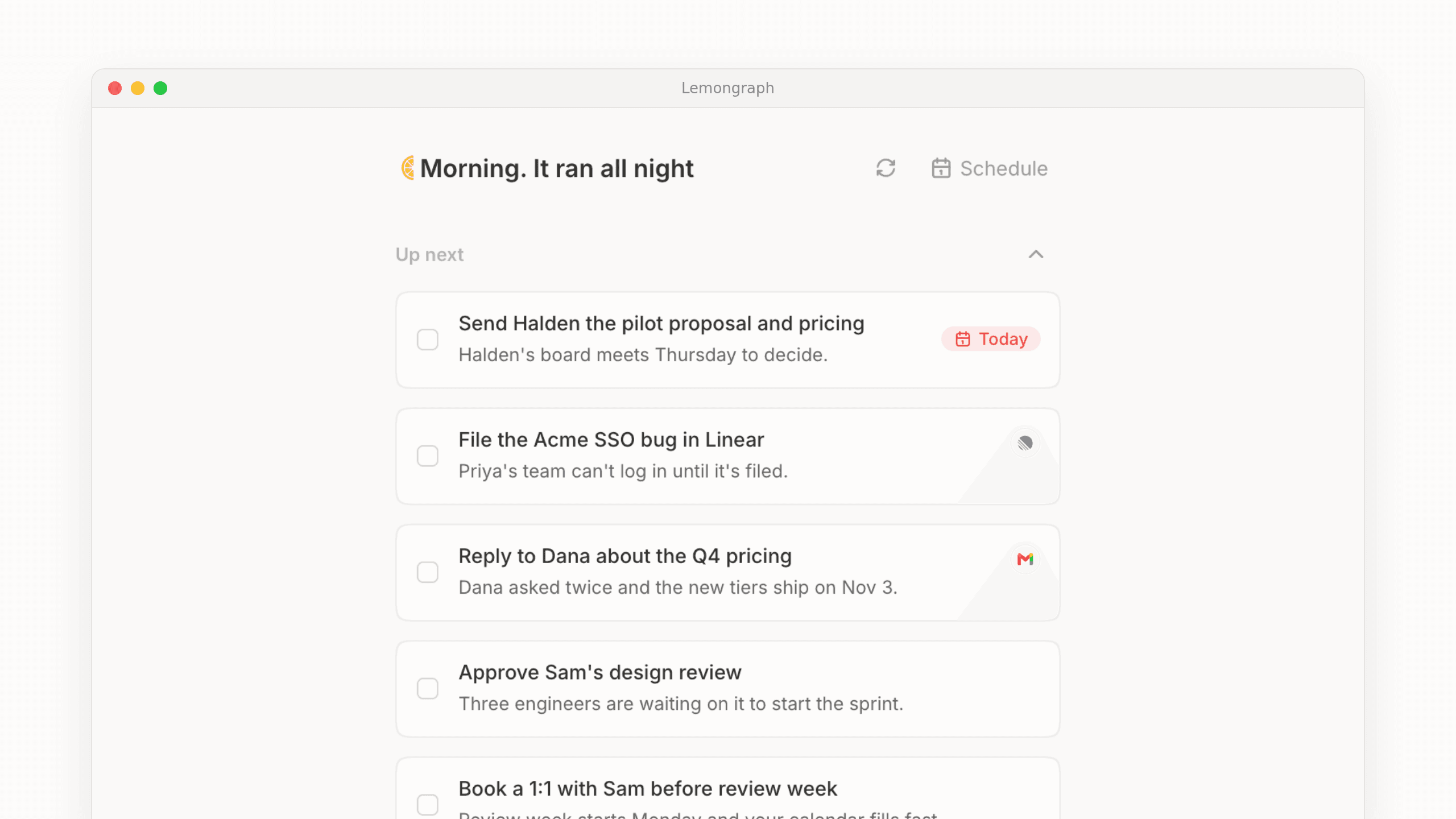
That's what we're building with Lemongraph, an AI native personal task manager for people whose work runs through other people, like founders, managers and consultants. Work lives in conversations and nearly every conversation ends with a promise. Keeping up with all of them becomes a job of its own. Lemongraph takes on that job, picking up action items from your email and meetings, watching for signals and prioritizing the way you would. When it creates a task from a meeting in Linear, Asana, ClickUp or monday.com, it works out the owner, the priority and the labels itself, weighing what was said against everything it knows about the work.
We should be honest about how we got here. Our first take on priorities leaned hard on due dates and we got that wrong. The thing with a date on it is rarely the thing on your mind. So we rebuilt Lemongraph to look a few steps further around each task, at the work and the people connected to it. Due dates still count. They just don't get the final say anymore.
Every morning Up next shows what matters today and why. That "why" matters to us more than almost anything else, because we won't get every priority right every day and you should never have to take our word for it. When plans change you can snooze anything and it comes back when you're ready. You never have to prompt it, since it learns how you work from the tools you connect. And anything it does on your behalf starts as "Ask first" until you're comfortable letting it go ahead.
Daily priority triage is included on every plan, including the free one, which comes with 5 integrations and 15 chore runs a month. Pro is $20 a month with 100 chore runs. It runs on the web and Mac and there's no iPhone or Android app yet.
To be upfront, Lemongraph is newer than most of the tools people use and it's built for people who'd rather not maintain their list by hand. If you love sorting your own list each morning with a coffee, one of the methods above may be all you ever need and that's a lovely way to start a day.
Frequently asked questions
What is the best way to prioritize tasks?
Get every task out of your head and into one place, then choose one to three things that genuinely matter and do them before the inbox takes over. Separating loud requests from work with real consequences keeps your best hours for the things that deserve them.
What is the 1-3-5 rule for prioritizing tasks?
It's a daily plan of one big task, three medium tasks and five small ones. Alexandra Cavoulacos, cofounder of The Muse, created it and describes it in The New Rules of Work, which she wrote with Kathryn Minshew. It keeps a day ambitious without letting it become impossible.
What is the 3-3-3 rule for tasks?
It comes from the author Oliver Burkeman's newsletter The Imperfectionist. You spend three hours on your most important project, do three shorter urgent or nagging tasks and take care of three maintenance activities that keep life running. Burkeman says the spirit matters more than the number three.
What are the 5 priority levels for tasks?
The best known version is Brian Tracy's ABCDE method, where A is must do, B is should do, C is nice to do, D is delegate and E is eliminate. Many teams also use simple levels in their trackers, like critical, high, medium, low and none.
What are your top 3 priorities at work?
On any given day, a good top three is the task that unblocks the people waiting on you, the work that moves your most important project forward and any promise that has a real consequence if it misses today. Everything else can wait its turn.
How do you prioritize tasks when managing multiple projects?
Rather than following whichever project has the loudest stakeholder, look at what each task actually unblocks. Protect focus time for the project with the biggest real consequence and tell people early when a date needs to move, so nobody is left guessing.
Is there an app that prioritizes tasks for you?
That's what we built Lemongraph for. It pulls tasks from your email and meetings and orders them each morning in Up next, showing you why every item is there, without you having to prompt it. If you'd like to compare it with more traditional apps, our guide to the best to-do list apps sorts them by who does the upkeep.
Meeting action items: how to write them, a free template and how to stop retyping them
What makes a good meeting action item, a real example, a free meeting minutes template with action items and how to stop retyping them after every call.
The best to-do list apps in 2026, sorted by who keeps the list
The best to-do list apps in 2026, from Todoist and TickTick to Motion and the free apps on your phone, sorted by who does the upkeep.