Meeting minutes template: a simple format and how to write minutes people actually read
A free meeting minutes template with a filled in example, what to write down, what to leave out and how to send minutes people will read.
Oct 7, 2026
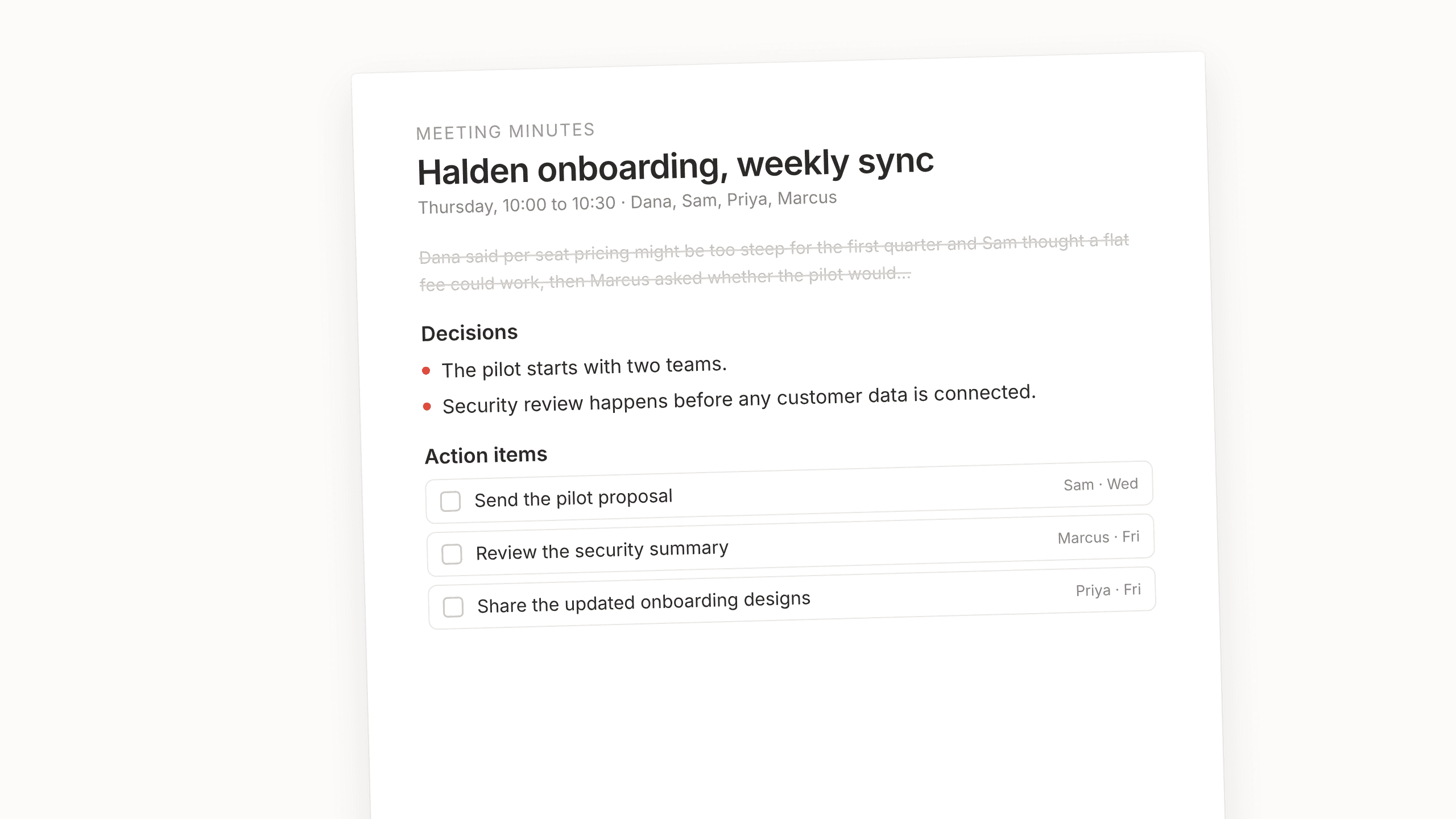
Meeting minutes record who was there, what was decided and who will do what by when. Keep them short, write down decisions instead of the conversation and send them within a day. There's a free meeting minutes template below that you can copy into your notes before the call starts.
What are meeting minutes?
If you've been asked to take minutes, it's easy to assume the job is to type everything everyone says. It isn't. Robert's Rules of Order, the guide most boards and committees use to run meetings, says minutes should contain "mainly a record of what was done at the meeting, not what was said by the members." (That's from the 11th edition, as quoted in the City of Madison's guidance on taking committee minutes.)
This one idea will make your minutes better than most. When minutes try to capture the whole discussion they get long, people stop reading them and the decisions end up somewhere in the fourth paragraph.
Formal minutes and working minutes
There are two kinds of minutes and it helps to know which one your group expects.
Formal minutes are for boards, committees, nonprofits and any meeting where people vote. They're an official record that someone may need to look up months later. They usually include the name of the group and the type of meeting, the date, time and place, who chaired and who attended, whether there was a quorum, whether the previous minutes were approved, each motion with its outcome and the votes, any reports and the time the meeting ended. Even formal minutes leave out the substance of the debate and anything verbatim, because writing down who said what tends to start arguments later about whether it was written down correctly.
Working minutes are for ordinary team and client meetings, where nobody is proposing motions. They list who attended, what was decided, the action items with owners and dates and anything still open. If you're reading this before a weekly sync, this is the kind you need.
| Formal minutes | Working minutes | |
|---|---|---|
| What they're for | An official record of decisions and votes | Keeping the team clear on what happens next |
| Attendance | Full list and whether there was a quorum | Who came and who didn't |
| Decisions | Each motion, who proposed it and the vote | One sentence per decision |
| Approval | Approved at the start of the next meeting | Sent within a day |
Meeting minutes template
If your meeting starts in five minutes, copy this into an empty doc.
Meeting minutes

Meeting: [Name]
Date and time: [Day, date, start and end time]
Location: [Room or video link]
Chair: [Name]
Minutes taken by: [Name]

Attendees: [Names]
Absent: [Names]

Agenda
1. [Topic]
2. [Topic]
3. [Topic]

Decisions
- [What was decided, in one sentence]

Action items
- [Verb + specific next step]
  Owner: [One name]
  Due: [Date]

Open questions
- [Things raised but not decided and who will follow up]

Next meeting: [Date and time]
Decisions and action items have their own sections, separate from the agenda. That way someone can open the minutes, see what changed and see what they owe without reading the rest.
For formal minutes, keep the same structure and add a few lines. Note whether there was a quorum under the attendance, add the approval of the previous minutes before the agenda, list each motion with who proposed it and the vote instead of the plain decisions and write down when the meeting ended.
Minutes of meeting format, filled in
Here's the same minutes of meeting format filled in for a thirty minute weekly project sync.
Meeting minutes

Meeting: Halden onboarding, weekly sync
Date and time: Thursday, 10:00 to 10:30
Location: Video link
Chair: Dana
Minutes taken by: Sam

Attendees: Dana, Sam, Priya, Marcus
Absent: None

Agenda
1. Pilot scope
2. Security review
3. Launch date

Decisions
- The pilot starts with two teams.
- Security review happens before any customer data is connected.

Action items
- Send the pilot proposal with per seat pricing and a security summary
  Owner: Sam
  Due: Wednesday
- Review the security summary
  Owner: Marcus
  Due: Friday
- Share the updated onboarding designs
  Owner: Priya
  Due: Friday

Open questions
- Launch date depends on the board meeting on 3 Nov. Dana will confirm next week.

Next meeting: Next Thursday, 10:00
The team spent about twenty minutes of that call going back and forth on pricing. None of it is in the minutes, only the decision they reached and who's doing what before next week. Priya could have missed the meeting entirely and still known what she needs to do by Friday.
How to write meeting minutes
It mostly comes down to a couple of minutes of preparation and a few habits during the call.
Before the meeting
- Get the agenda and paste the template into a doc with the agenda topics already filled in.
- Add the names of everyone who's expected, so during the meeting you only have to mark who's missing.
During the meeting
- Write down decisions and action items as they happen. Don't try to summarize the conversation.
- When something sounds decided, check out loud. "So we're going with two teams?" It can feel a bit awkward the first time, but it stops two people from leaving with different versions of what was agreed.
- Before the group moves on, make sure every action item has one owner and a date. When two people own a task, each tends to assume the other is doing it.
After the meeting
- Clean up your notes the same day, while you still know what your shorthand meant.
- Send the minutes within a day to everyone who attended and anyone else who needs to know.
- For formal meetings, the minutes are approved at the start of the next meeting. That's when people can ask for corrections.
What not to include in meeting minutes
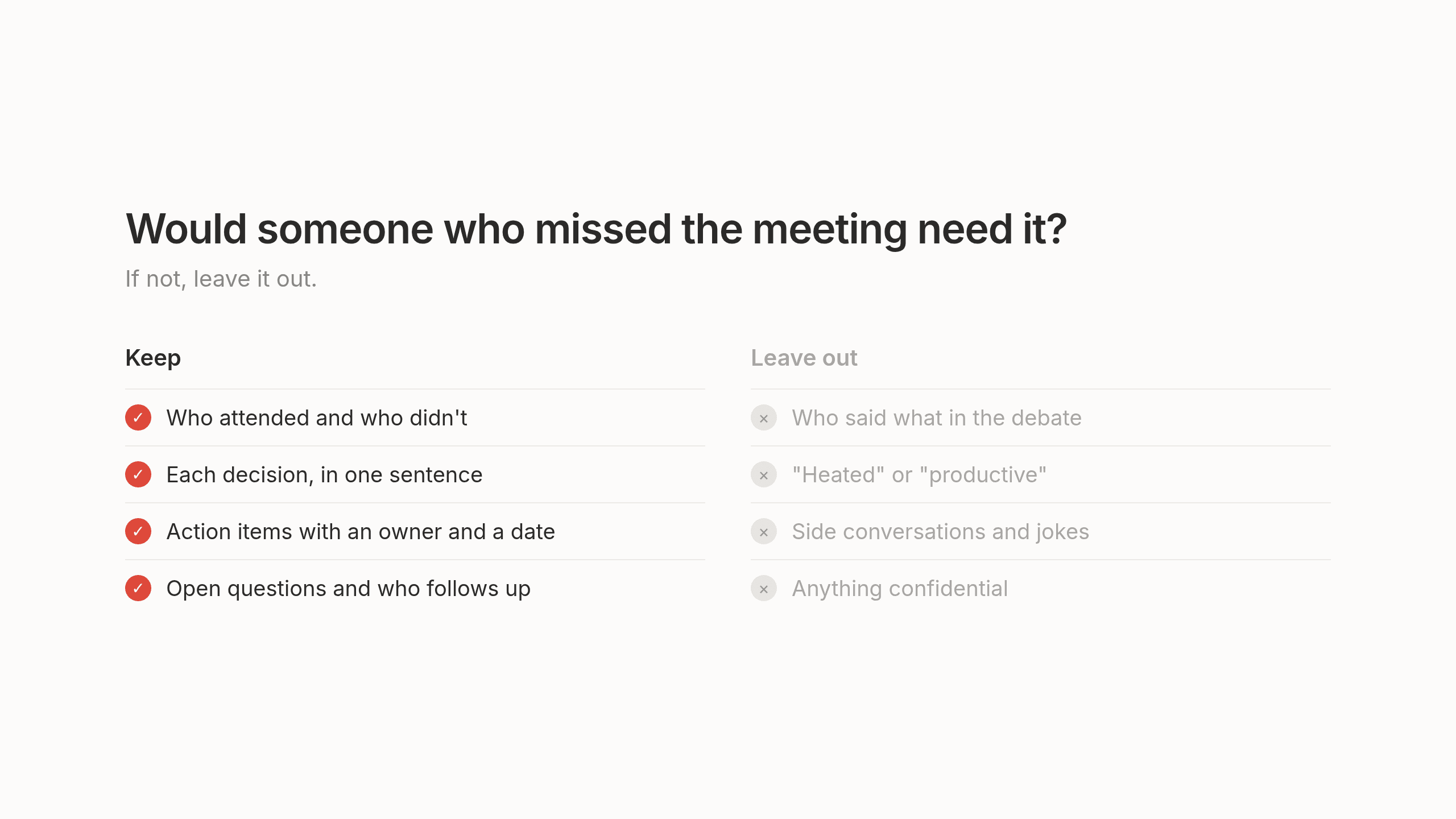
Leave out the blow by blow of the discussion and who said what, unless it's a formal vote or someone asks for their position to be recorded. Leave out your opinion of how the meeting went, including words like "heated" or "productive". Side conversations and the jokes while everyone was joining don't belong either. Neither does anything confidential that shouldn't go to everyone on the list.
If you're unsure whether something belongs, ask yourself whether someone who missed the meeting needs it to do their job. If not, leave it out.
Once the minutes are sent
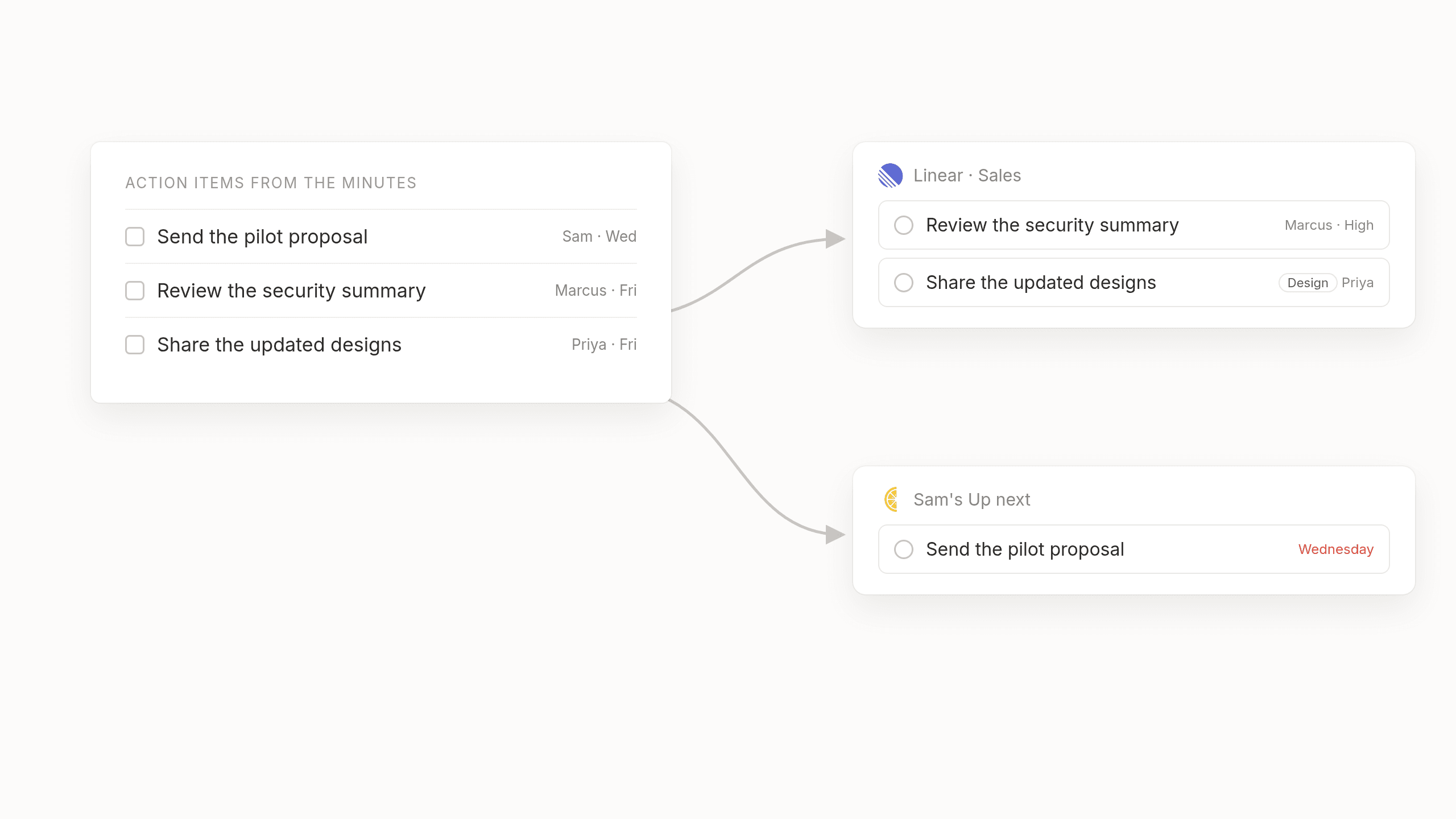
Minutes are a record of what people agreed to do. After you send them, the action items still have to get into the places where work happens, like the team's project tracker and each person's own to-do list. Most of the time someone copies them over by hand between other meetings and that's when items get dropped.
We built Lemongraph, an AI native personal task manager for people whose work runs through other people, like founders, managers and consultants, partly for this. It picks up action items from your meetings and email without you copying them over. When it creates a task from a meeting in Linear, Asana, ClickUp or monday.com, it works out the owner, the priority and the labels itself, based on what was said and what it knows about the work. Your personal follow ups go on your own list and every morning Up next shows what matters today and why. If you'd like more on writing next steps people can act on, we wrote a guide to meeting action items.
Lemongraph asks before every action. When you're ready, you can give it permission in small steps, one chore or one contact at a time. The free plan includes 5 integrations and 15 chore runs a month and Pro is $20 a month for 100. It runs on the web and Mac.
For formal board minutes, a person still needs to write and approve the official record. Lemongraph helps with the work that comes after.
Frequently asked questions
What is the best way to write meeting minutes?
Paste the agenda into a template before the call and only write down decisions and action items as they happen. When the group seems to have decided something, confirm it out loud before moving on.
What is a simple format for meeting minutes?
Meeting details and attendees at the top, then the agenda, a short list of decisions, action items with one owner and a due date each and any open questions.
What should not be included in meeting minutes?
A transcript of the discussion, who said what during a debate, opinions about how the meeting went, side conversations and anything confidential.
Who should take meeting minutes?
Ideally someone other than the person running the meeting. It's hard to lead a discussion and write down decisions clearly at the same time.
How soon should meeting minutes be sent out?
Within a day. Clean them up the same day while you still remember the details, so people can start on their action items right away.
Can meeting minutes be automated?
Partly. For formal board and committee minutes, a person still needs to write and approve the record. For everyday meetings, Lemongraph can pick up the action items from your meetings and put them into your project tracker and your own to-do list, asking you first.
Meeting agenda template: how to prepare an agenda that makes meetings shorter
A free meeting agenda template with a filled in example, versions for one on ones, client meetings and team weeklies and how to write one.
Follow-up email after a meeting or sales call: templates that still sound like you
Six follow-up email templates for after a meeting or sales call, when to send them and how to keep them sounding like you.