The work behind work: rethinking personal task management
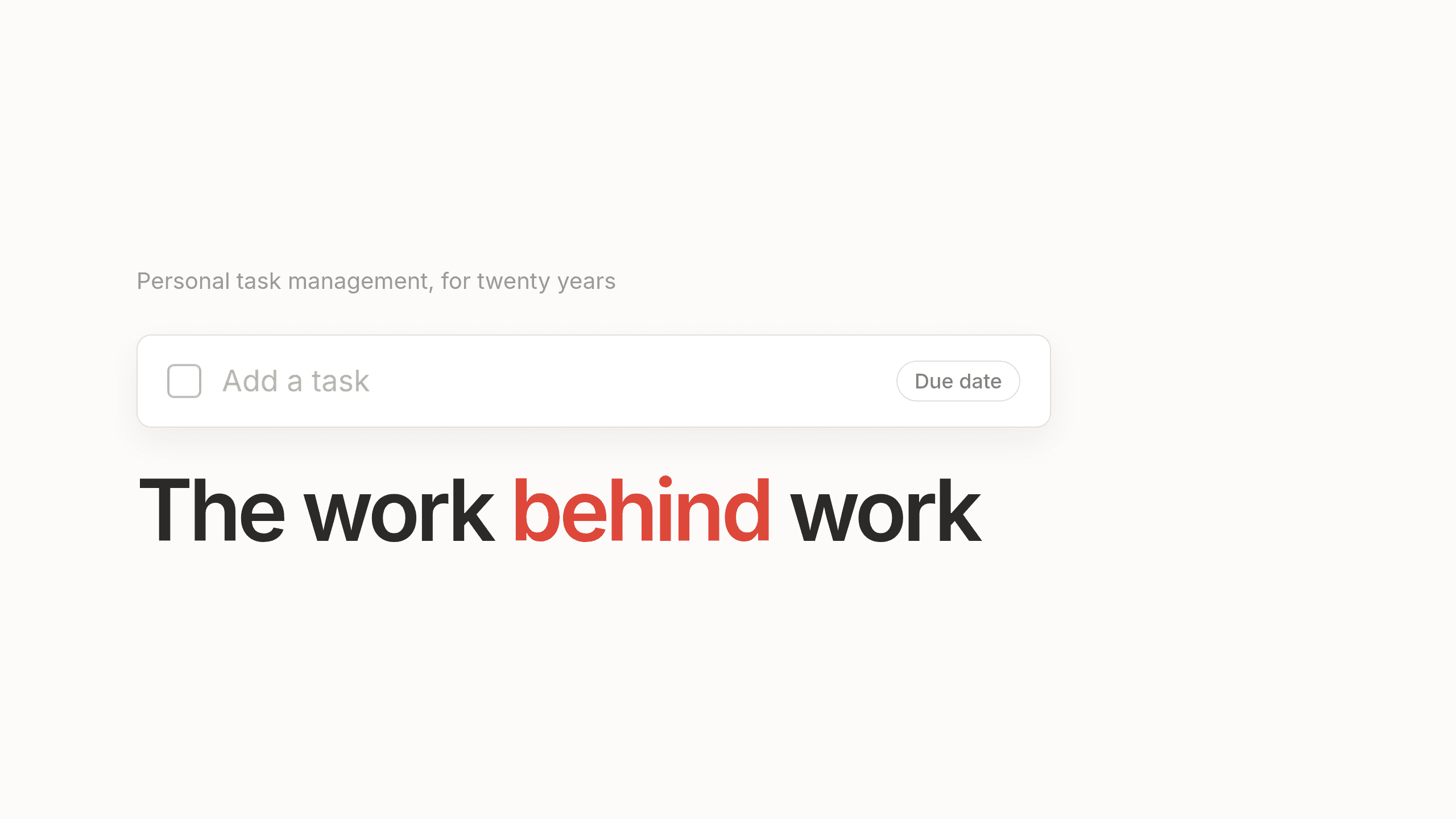
For twenty years personal task management has looked the same, a text box, a checkbox and a date. What it looks like when the list keeps itself up to date.
Oct 30, 2026
Most of us are judged less on any single piece of work than on the quality of our interactions with other people. Did you send what you said you'd send? Did you remember the thing someone mentioned in passing two weeks ago? Trust and clarity are what make working with someone feel good and none of it is especially complicated. But staying consistent, across dozens of conversations a week, is itself a large part of the work. It's the work behind work.
Personal task management was supposed to help with that. And for twenty years it has mostly looked the same. A text box, a checkbox and a date. The apps have become faster and prettier and much better at understanding "next Thursday at 3pm" and a few have learned to fit your list into your calendar. But the shape hasn't changed. You notice the task, you write it down, you decide how much it matters and you move it when the week falls apart. The app holds the list. You do the work of keeping it true.
We've been rethinking that.
Work lives in conversations
If you invent your own tasks, a classic list works beautifully. But if your work runs through other people, most of your tasks aren't invented. They're agreed to. A client asks for a revised proposal in an email. Someone says "can you loop in Marcus?" as a call wraps up. Your manager drops a question that quietly turns into half a day.
Work lives in conversations and each one ends with a promise. Keeping up becomes a job of its own. You reread threads to find what you said yes to and copy action items from meeting notes into a tracker between back to back calls. Then there's the list in your head for things that don't belong anywhere, like the intro you promised someone last week. And every morning you sort it all by hand, mostly by due date, because the due date is the only signal your app can see.
So we started with a simple question. What if personal task management took on that job? Picking up action items, watching signals and prioritizing the way you would.
What changed
For a long time nothing could take on that job, which made the text box a fair deal. That's no longer true. Models are now good enough at reading messy human context, like an email thread or a meeting transcript, to tell a real commitment from a pleasantry. They're also cheap enough to do it all day, for every message, without anyone worrying about the bill. We test every model before it earns a job and the surprise has been how much of this work the cheapest tier handles just fine.
AI is the first technology that can help us carry that consistency into everyday work. The capability isn't the bottleneck anymore. The product shape is.
Why not an assistant
Most AI products in this space arrive as a chat box or a general purpose assistant. You ask, it answers and it promises to do a little of everything. That's useful, but it quietly makes you the manager of your own software. You have to remember to ask, know what to ask for and explain your week before it can help.
We made one rule early on. You should never have to prompt it. Think of the best colleague you've ever had. You never had to brief them on your week. They knew what mattered and had it ready before you asked. That's the bar.
It also means saying no to a lot. Lemongraph won't order your pizza or plan your vacation. It's built for one kind of day, the one where your work runs through other people.
What ambient task management looks like
In practice the job breaks down into four parts.
Picking up action items. When a commitment appears in an email or a meeting, it should become a task without you copying it anywhere and it should land where the work lives. If it belongs in the team's tracker, it should arrive with an owner, a priority, labels and the context that explains why it exists. If it's personal, it lands on your own list.
Watching signals. A due date is one signal and often not the most important one. Who's asking matters. What the task unblocks matters. How it connects to the rest of your work matters. Good software should be paying attention to all of it, quietly, while you work.
Prioritizing the way you would. Every morning you should get a short list of what matters today, ordered the way you'd order it if you had an hour to think and every item should say why it's there. You should never have to take software's word for what matters in your life.
Spotting chores. A chore is repetitive work, the kind you could hand to someone if you had someone. A brief before an important meeting. A Friday progress report. Ambient software should notice these from what you actually do, rather than asking you to configure them. In Lemongraph a spotted chore shows up with a Hire button. Hire it once and next time it only asks for your OK.
What we got wrong and what we learned
A few lessons from building this surprised us.
Due dates lie. Our first take on priorities leaned hard on them and it felt wrong almost immediately. The thing with a date on it is rarely the thing on your mind. There's research on this too. Zhu, Yang and Hsee's 2018 paper on the "mere urgency effect" found people consistently choose tasks that merely have a short deadline over tasks with better payoffs. A list sorted by due date doesn't correct that bias. It trains it. So we started looking a few steps further around each task, at the work and the people connected to it. Due dates still count. They just don't get the final say anymore.
Keep the model's job small. It's tempting to let one large model decide everything. We found the opposite works better. When a meeting produces a commitment, the model only decides that something should become a task. Nothing more. Where that task lives, whether that's Linear, Asana or your personal list, is decided by a separate deterministic system. Keeping those jobs apart makes the results far more predictable and predictability is most of what trust is made of.
Never grade your own work. Some chores take days, not seconds. Behind Lemongraph is a runtime that stays with the work for as long as it takes and completion is checked deterministically against what actually happened. The software never gets to decide on its own that it did a good job.
Zero trust, handed over in small slices. It asks before every action. When you're ready, you hand it permission one chore or one contact at a time. That's slower at the start and we think that's right. Nobody hands over their inbox to something they met yesterday.
Learn the context up front. Rather than learning about you slowly through conversation, Lemongraph reads the tools you connect at sign-up to understand how you work and who you work with. The relationships matter as much as the tasks. How you work with your manager is different from how you work with your team or a client and good prioritization should know the difference.
Charge for outcomes, not tokens. Credits never made sense to us. You don't pay a plumber per turn of the wrench. So we price per chore that actually gets done and if one doesn't finish, it doesn't count.
Why the existing apps aren't heading here
This surprised us most. The classic to-do apps have all added AI in the last couple of years and some of it is genuinely good. You can speak a task instead of typing it, forward an email to have its action items pulled out or have a vague task broken into smaller ones. Planning apps will take your list and fit it into your calendar.
But nearly every one of those features makes the same assumption. The list is still yours to keep. The AI helps you type faster, sort faster or schedule what you already wrote down. Nobody has rebuilt personal task management around the idea that the list could keep itself up to date. We suspect that's partly because it's hard to get there from a product built around a text box and partly because charging a subscription for a place to store your list is a very comfortable business.
That leaves a surprisingly open space. General purpose assistants are busy promising to book trips and order groceries and to-do apps are busy polishing the text box. Very few people are working on the everyday middle, the steady stream of small promises that decides whether people trust you. We think that's where most of the value is.
What's still unsolved
We'd be overselling if we didn't say this plainly.
Noise is the hardest problem. Software that creates tasks on its own can easily create too many and a list full of things you'd never have written down is worse than no list. Knowing when to stay quiet matters as much as knowing when to act.
Privacy is a real cost. Ambient software has to read the places where your work happens and that's a lot to ask. Our answer is to be plain about it. Our AI partners can't train on your data, we will never sell it and deleting your account erases everything for good. We'd still rather you start small and widen access as you trust it.
And priority is personal in ways that are hard to measure. There's no ground truth for the right order of a Tuesday. We lean on explanations and quick corrections, because we don't think anyone, software or human, gets this right without feedback.
Where this goes
We don't think the future of personal task management is a better text box or a smarter chat window. We think it's software that pays attention while you work, catches your promises, notices your chores, quietly takes on the ones you hand it and gives you a short, well reasoned list each morning. You stay in charge of what matters. It takes care of the work behind work.
That's what we're building with Lemongraph, a to-do list that keeps itself up to date. It's early, it runs on the web and Mac and there's a free plan if you'd like to see whether it gets your Tuesday right. We'd genuinely love to hear where you think we're wrong, especially if you've tried to build something like it.