AI second brain for busy people: remember every action item from your conversations
Learn what an AI second brain is and how busy people can use one to remember every action item from their daily conversations without manual upkeep.
Nov 22, 2026
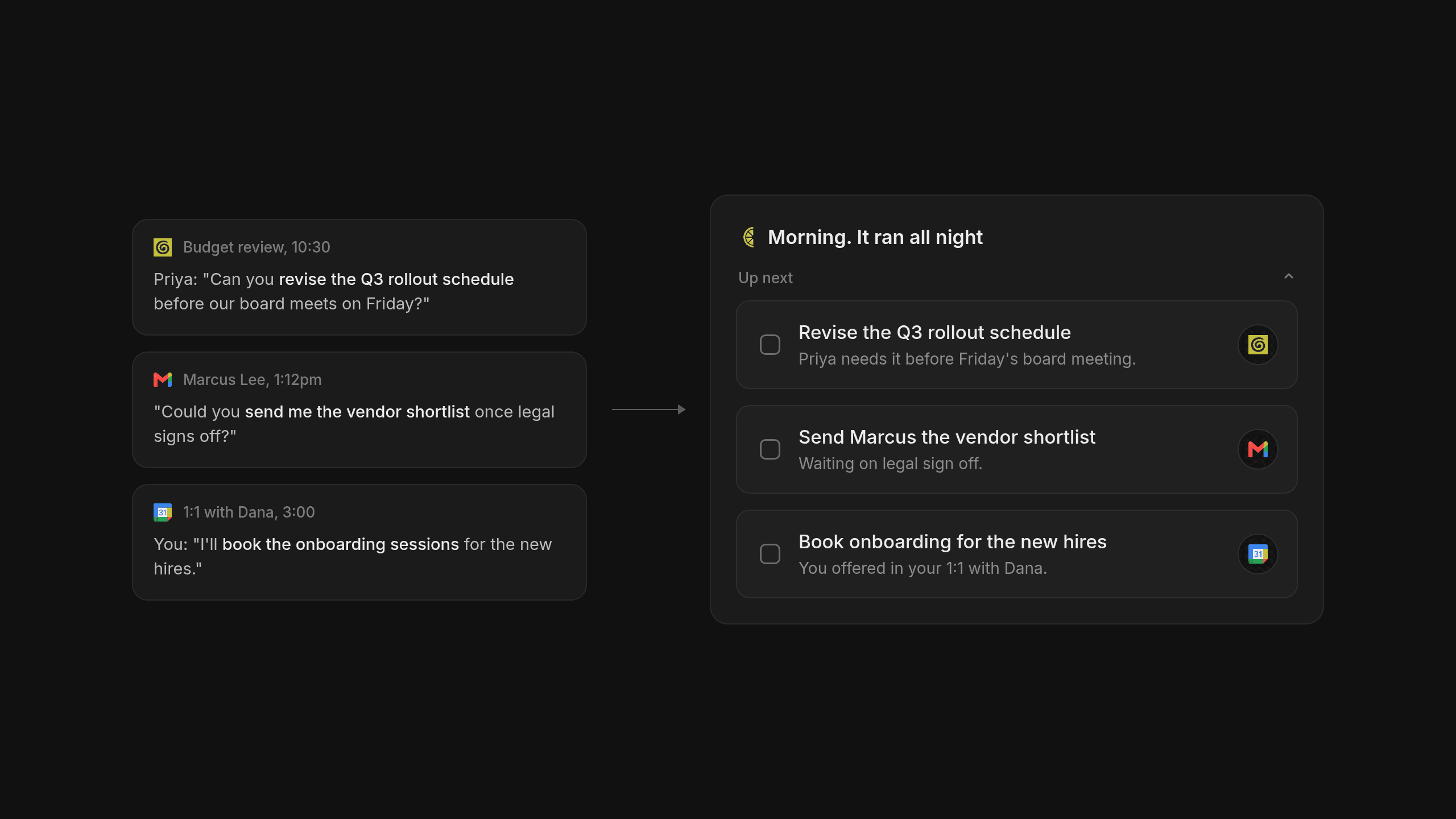
When Tiago Forte published his book Building a Second Brain in 2022, he gave a name to a feeling millions of us already had at work. Now an AI second brain can take that original idea and do most of the work for people whose days are completely full of conversations. You probably know the exact feeling that shows up around six in the evening after a long string of discussions. You close your laptop with the uneasy sense that you agreed to do something for someone earlier in the day and you cannot remember what it was or where you said it. Our brains are wonderful at thinking through hard problems and terrible at storing little details for later. That simple truth is why people started building a second brain in the first place, while artificial intelligence is now changing what one can actually do for busy people who do not have spare hours to organize folders.
What is a second brain and why an AI second brain helps
Before we talk about where artificial intelligence fits in, it helps to look at the original idea in plain words. The term second brain was made popular by Tiago Forte and his 2022 book about building a second brain. In his introductory guide on Goodreads, Forte defines a second brain as "an external, centralized, digital repository for the things you learn and the resources from which they come." In everyday language, that simply means having one trusted place outside your head that holds what you learn and what you need so you do not have to carry it all in your working memory.
To make that repository work in daily life, Forte teaches a four step method called CODE. You start when you Capture ideas worth saving, then you Organize those notes into places where they belong so you can find them again. Over time you Distill each note down to its core point, which finally lets you Express what you know by creating something new for your team or your clients. It is a thoughtful way to treat information with care instead of letting good ideas wash away in the daily flood of messages.
Why most second brains don't survive a busy week
We love the clarity of Forte's method, yet we also have to be honest about what it asks from you on a regular Wednesday afternoon. A classic second brain depends entirely on you capturing and organizing everything by hand. That manual care is an honest tradeoff of the method rather than a flaw in his idea. If you are a writer or a researcher with long stretches of uninterrupted time, filing your own notes is part of the craft and feels genuinely rewarding.
If you are a manager or a consultant whose day is packed with back to back conversations, that manual upkeep is the very first thing to fall away when work gets intense. You finish one call while another person is already waiting for you in the next room, so you tell yourself you will write down the follow up items after lunch. By Friday afternoon, thirty conversations have gone by without a single note filed. Most busy people end up with a beautiful folder system they stopped using in week three because maintaining the system became an extra job on top of their actual job, which is why we wrote about rethinking personal task management for people whose days belong to other people.
What an AI second brain changes
This is where the AI second brain concept changes the daily experience for people who live in conversations. Instead of waiting for you to type up notes and sort them into folders at night, the system notices what matters in the conversations you are already having across your email and your meetings. It shifts the tool from a static library that waits for you to file things into a system that pays attention while your workday happens.
Many people try to build an AI second brain Claude setup on their own by connecting their notes to Claude or ChatGPT. We have tried this too, and it feels great for the first few days until the setup needs care. Pretty soon you notice that every chat starts from zero so the background context has to be pasted in all over again before you can get a useful answer. If you have ever wondered why AI forgets you and how context engineering works, it comes down to the fact that general chat tools do not watch your workday unfold unless you feed them every single detail by hand.
| What changes | Classic Second Brain | AI Second Brain |
|---|---|---|
| How information gets in | You type notes and clip links by hand | The system notices what matters in your conversations |
| What happens during a busy week | Filing falls behind when meetings stack up | Updates continue without manual sorting |
| Primary focus | Storing book notes and reference articles | Catching action items and the story behind them |
| Starting a task in Claude or ChatGPT | You copy and paste background notes into a fresh chat | Full background context is already attached |
What busy people need most: action items
If you ask someone with a full calendar what they are actually afraid of forgetting, they rarely say it is an article they read last month. For busy people at work, the most valuable thing a second brain can hold is the stream of action items that come out of daily conversations. When you spend your day talking with teammates and clients, those meeting action items get lost in the awkward gap between a lively conversation and your to-do list.
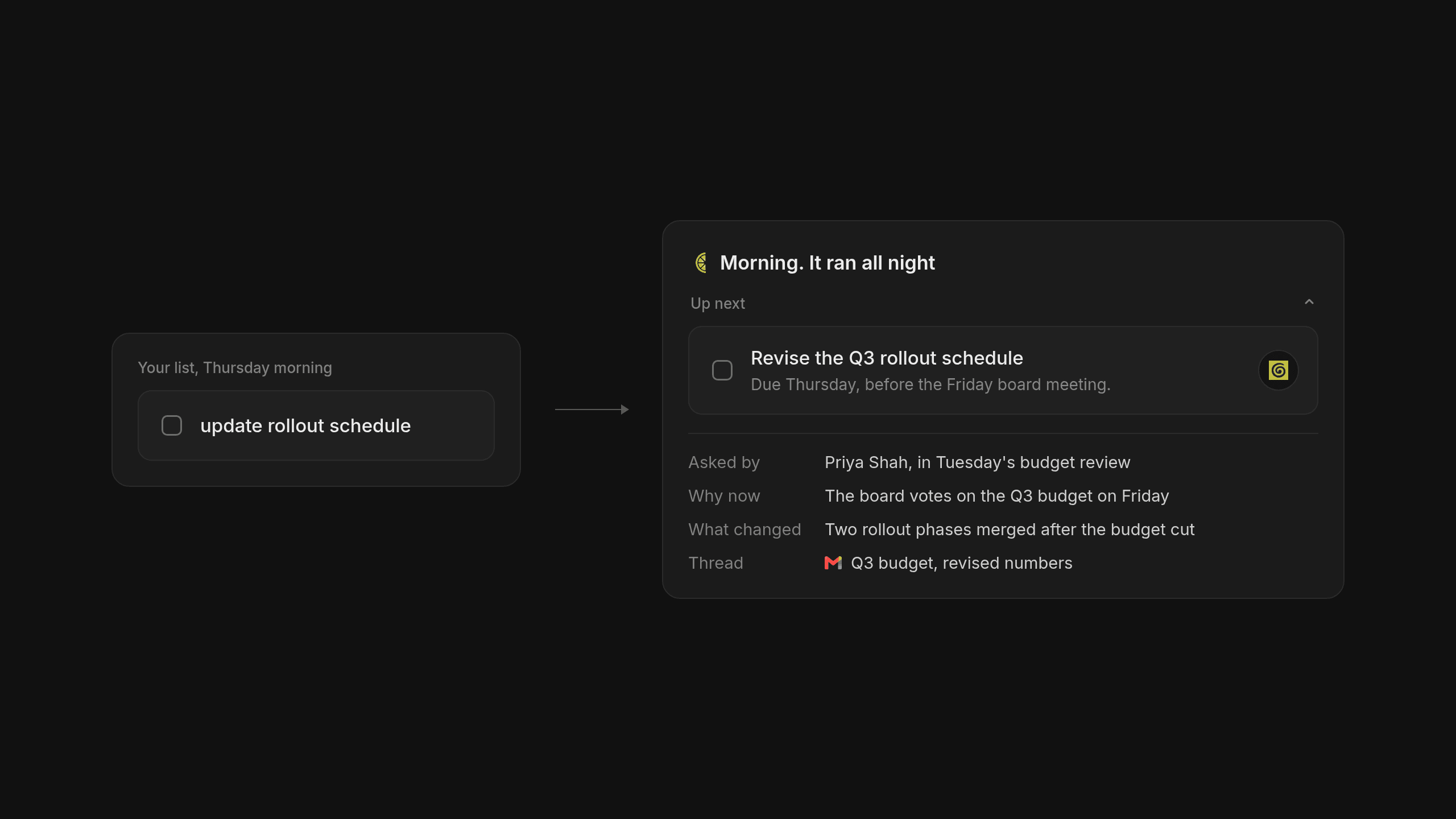
Even when you manage to scribble three words on a sticky note before your next call starts, an action item written down without its story is half useless when you look at it two days later. To actually do the work without digging through old messages for twenty minutes, you need the surrounding story attached right from the start, including who asked for the work during the conversation, why the work matters right now and what happened in the project right before the request.
Think about a real moment from a typical week, like when a client asks during a budget review to revise the third quarter rollout schedule before their board meets on Friday. If your list only says update rollout schedule, you will stare at it on Thursday morning trying to remember which numbers changed. When the action item carries the reason for the Friday deadline and the link to the budget thread, you can sit down and finish the work right away.
People are part of your second brain too
There is another piece of your workday that traditional note systems ignore completely. Most second brains store documents as if your work happens in an empty room, yet almost every action item on your list exists because of a specific person. Knowing how you work with each individual person changes how you handle the work itself.
Think about the difference between two people you talk with every week. Your manager wants a two line summary they can read on their phone between flights, while a client wants the full story with every number explained before they share it with their team. A thoughtful AI second brain app learns these working styles directly from how you actually work with each person over time, instead of asking you to sit down and write out contact profiles and communication rules by hand.
What an AI second brain looks like in practice
We built Lemongraph to show what this looks like when a tool is designed around your workday rather than your filing habits. Lemongraph is a personal task manager on the web that reads the tools you connect, like your email and calendar or your meeting notes and task trackers, so it can understand how you actually work. Instead of waiting for you to copy things over at the end of the day, it finds action items in your conversations on its own and puts each one in the right place, such as Linear or its own list, with the full story behind it attached.
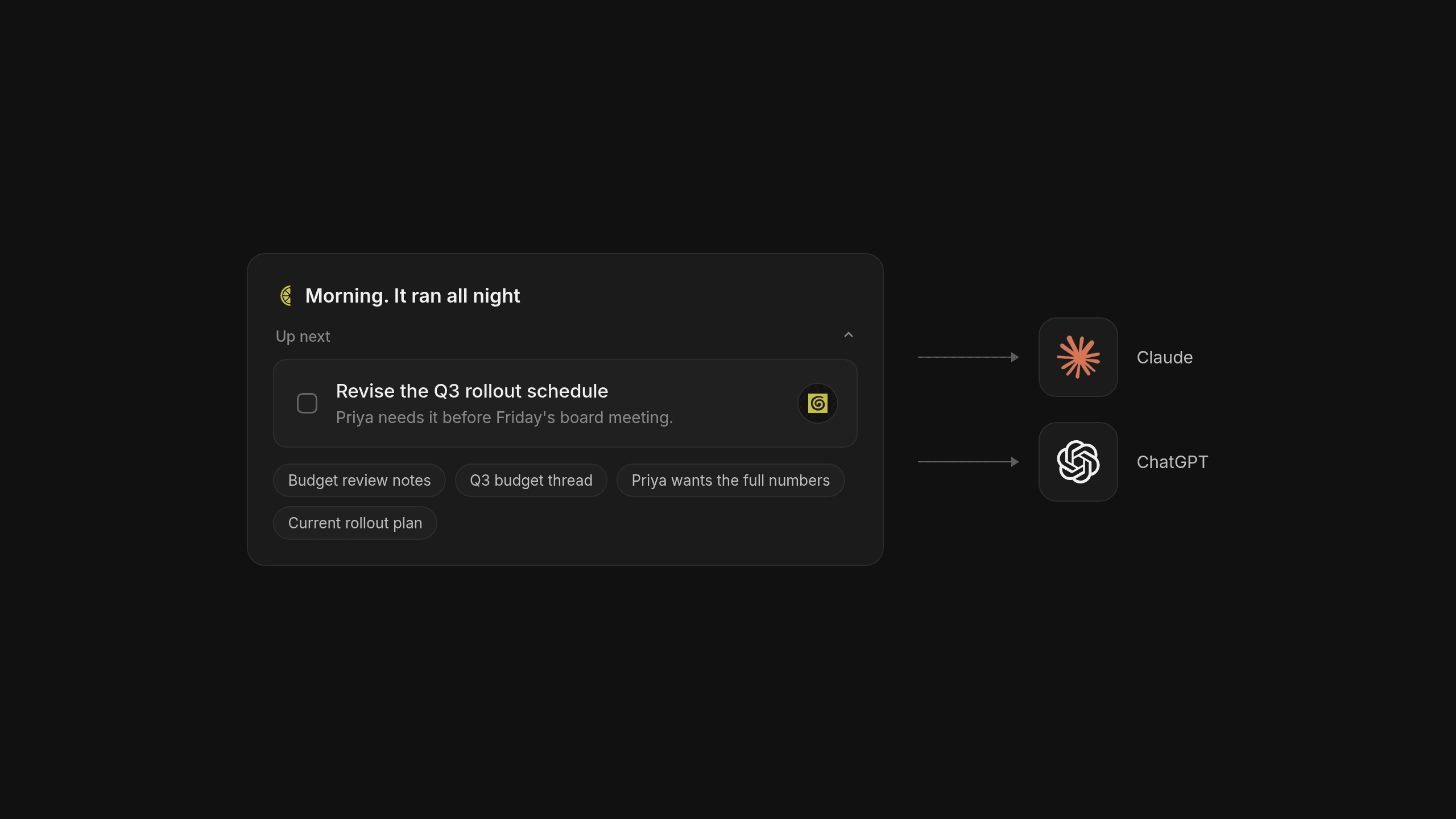
As you go through your week, Lemongraph learns how you work with each person in your orbit, because it notices that working with your manager is very different from working with a client. Every morning it helps you see the few things that matter today so you do not have to start the day sorting a giant backlog. When you are ready to do the work, your other agents such as Claude or ChatGPT can pick up an action item with that full context already attached, so they start in seconds and use far fewer tokens.
How to start today
If you have tried building a system in the past and gave up when work got busy, the best way forward is to make the setup much smaller than you think it needs to be. Start with just one source of conversations rather than trying to connect every tool you use all at once, because seeing your action items show up from a single place builds trust right away.
As you test it out over the first few days, judge a second brain by whether it saves you time this week rather than by how organized it looks on your screen. A plain list that catches what you agreed to do in a conversation will always beat a color coded folder tree that you stop updating by next Tuesday.
Finally, if you already use Claude or ChatGPT to help with your daily writing and planning, give them context about your work and the people around you instead of starting fresh every chat. The less time you spend explaining who your client is or what happened in yesterday's meeting, the faster those tools can actually help you finish your work.
Frequently asked questions
What is an AI second brain?
An AI second brain is a digital tool that remembers important details and action items from your workday automatically. Instead of asking you to type and file notes by hand, it pays attention to your conversations and organizes what you need to do next along with the background story.
What is the difference between a second brain and an AI second brain?
A traditional second brain is like a personal library where you write down notes and sort them into folders yourself. An AI second brain does that gathering and sorting for you by noticing what matters in the conversations you are already having across tools like email and meetings.
Can I use Claude as a second brain?
You can connect your notes to Claude, and many people try this first. The limit you will run into is that Claude does not watch your conversations happen on its own, which means every new chat starts from zero unless you paste in the background story or pair it with a tool that attaches that context for you.
Do I need to organize everything myself?
No, you do not need to organize folders or tags yourself when you use an AI native tool. The system reads the tools you connect and places each action item where it belongs with the relevant people and history already linked.
Is an AI second brain only for notes, or also for action items?
While classic systems were built mostly for saving book notes and articles, a modern AI second brain is built for action items too. For busy people whose days are full of conversations, catching every action item and why it matters is the most helpful job the system can do.
Think back to that six o'clock feeling at the end of a long day of conversations. Now imagine closing your laptop knowing that every action item from your conversations is already where it belongs, with the people and the full story attached for tomorrow morning. If you want a personal task manager that pays attention so you do not have to maintain a list by hand, you can try Lemongraph on the web today.
Claude usage limit reached? How to stop burning tokens on context you already have
Hitting the claude usage limit mid afternoon? Learn what tokens actually are and how to stop burning your allowance on context you already have.
Context engineering for non-engineers: why your AI keeps forgetting you
Learn what context engineering means in plain words for everyday ChatGPT and Claude users so you can stop repeating yourself in every new chat.